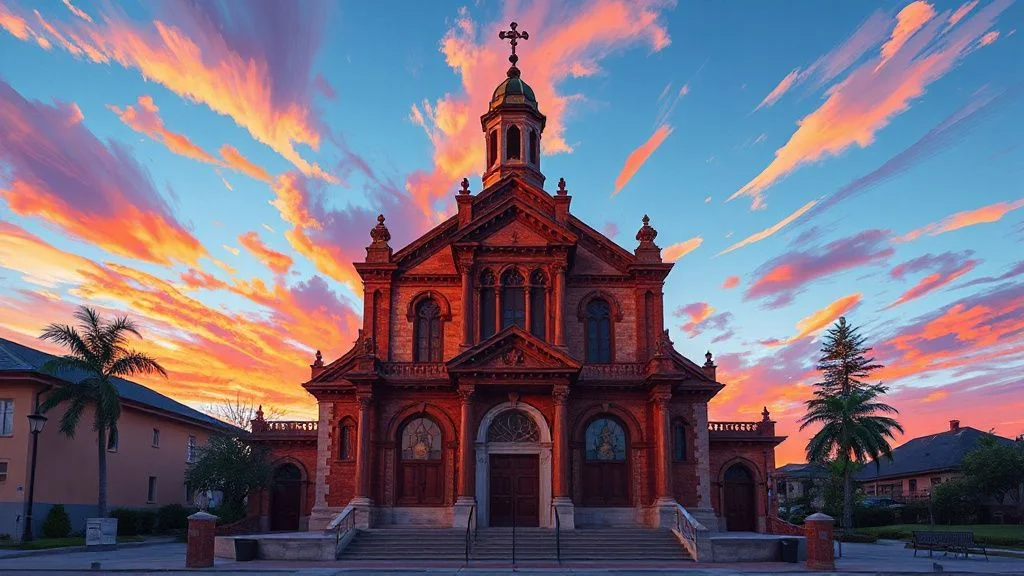
This article was supposed to be a guide to Brazilian churches in Georgetown: which congregations meet where, what the services are like, which festivals fill the calendar. We could not write that, and the reason is worth more to you than the article would have been. We found no published register, address list or schedule of services for a Brazilian congregation in Georgetown that we were able to verify. What follows is what is actually published, which turns out to be the part that affects your rights.
Why this article does not give you a number
You will see figures for the size of the Brazilian community in Guyana. We are not going to add one. There is no source we could verify for it, estimates of migrant communities in a country with a long and porous interior frontier diverge wildly, and a confident number in a guide is how a guess becomes a fact. The same goes for attendance at any particular congregation, and for the languages a given service is held in.
That is a real limit, so here is what it means in practice. If a number matters to your decision — because you are planning a business, a school place or a congregation of your own — treat every published figure as unsourced until the body that collected it tells you how. Ask what was counted, when, and by whom.
What the Constitution guarantees, in its own words
The protection you can actually rely on is constitutional, and it is unusually broad. Article 145 of the Constitution of the Co-operative Republic of Guyana, Chapter 1:01, in the 2012 revised edition read on 24 October 2026, provides:
Except with his or her own consent, no person shall be hindered in the enjoyment of his or her freedom of conscience, and for the purposes of this article the said freedom includes freedom of thought and of religion, freedom to change his or her religion or belief, and freedom, either alone or in community with others, and both in public and in private, to manifest and propagate his or her religion or belief in worship, teaching, practice and observance.
Three further subsections are worth knowing because they answer practical questions. Article 145(2): No religious community shall be prevented from providing religious instruction for persons of that community. Article 145(3) protects a person at a place of education from being required to receive religious instruction, or attend a ceremony, belonging to a religion that is not their own — with the consent of a legal guardian standing in below the age of eighteen. Article 145(4): No person shall be compelled to take any oath which is contrary to his or her religion or belief, which matters the first time you are sworn in front of an official. Article 145(6) extends every reference to a religion to a religious denomination, so a single congregation is covered, not only a recognized faith.
Article 145(5) sets the limits: a law is not inconsistent with the article to the extent that it is reasonably required in the interests of defense, public safety, public order, public morality or public health, or to protect the rights of others, including the right to observe and practice any religion without the unsolicited intervention of members of any other religion. If your plans involve public proselytizing, that clause is the one to read closely.
The limit worth knowing before you rely on equal treatment
Article 149 protects against discrimination, and article 149(2) defines it broadly: different treatment attributable to a person's description by race, place of origin, political opinion, colour, creed, age, disability, marital status, sex, gender, language, birth, social class, pregnancy, religion, conscience, belief or culture. Place of origin, language, religion and culture are all in that list.
Then read article 149(3)(a). The rule that no law shall be discriminatory does not apply to a law with respect to persons who are not citizens of Guyana. That is not a loophole in practice so much as a description of how immigration, work and property law operate everywhere, but it does mean the constitutional guarantee is strongest where it concerns religion and conscience and weaker where a rule turns on your nationality. Know which of the two you are arguing about.
Where a complaint about ethnic or religious treatment goes
Guyana has a constitutional body for this, which is more than most places offer. The Ethnic Relations Commission's functions are set out in article 212D. Among them: to encourage and create respect for religious, cultural and other forms of diversity in a plural society, and to investigate complaints of racial discrimination and make recommendations on the measure to be taken if such complaints are valid, referring matters on where justified. The article also gives it a mandate to establish mechanisms for arbitration, conciliation and mediation. If something goes wrong on grounds of origin or faith, that is a named destination rather than a vague appeal to goodwill.
The calendar that is actually statutory
The concept behind this article had a festival calendar in it. Here is the published one. The Public Holidays Act, Chapter 19:07, section 3(1), in the 2012 revised edition read on 24 October 2026, makes these public holidays: every Sunday; the first week-day of January; Republic Day as appointed by notice in the Gazette; Good Friday; Easter Monday; Labour Day, being 1 May; Commonwealth Day, being the first Monday in August; Christmas Day; 26 December; Phagwah Day; Deepavali Day; Eid-Ul-Azha Day; and Youman Nabi Day. A public holiday is defined in section 2 as a day kept as a holiday by all banks, educational establishments, public offices and government departments.
Two mechanics follow from that. Section 3(2) requires the Minister to publish the dates of the movable four — Phagwah, Deepavali, Eid-Ul-Azha and Youman Nabi — in the Gazette each year, as soon as reasonably practicable beforehand. And section 6 lets the Minister appoint any day as an additional or substitute public holiday by notification in the Gazette, which is how days not listed in section 3 appear on the year's calendar. So the annual calendar comes from the Gazette, not from a guide — and no Brazilian observance appears in the statutory list. If you were told Carnival or Festa Junina is a holiday in Georgetown, nothing in the Act supports it. Private communities can of course mark whatever they wish; that is article 145. It simply is not a day off.
Language: English is what the paperwork runs on
One hard language fact we could verify, and it is an administrative one rather than a cultural one. Guyana's Immigration Support Services sets this condition on its visa applications, read on 24 October 2026: All supporting documents that are not in English must be submitted along with an English translation.
That rule reaches further than a visa form. A Portuguese marriage certificate, birth certificate, police clearance or school transcript will need a translation before an office here will act on it, and arranging that from inside Guyana is slower and more expensive than arranging it before you travel. Budget the translations early. Beyond that, what languages are spoken in which rooms in Georgetown is not something we can source, so we are not going to characterize it.
What expats should know
- Treat any list of Brazilian congregations in Georgetown as unsourced until the congregation itself confirms its address and times to you.
- We will not publish a community size. No figure we found was traceable to a method.
- Article 145 is broad and expressly covers worship in private and in public, alone or in community, and the right to propagate a belief.
- Article 145(2) protects religious instruction within a community, and article 145(4) protects you from an oath contrary to your belief.
- Article 149(3)(a) carves out laws about non-citizens from the non-discrimination rule. Immigration and work rules are a different argument from religious freedom.
- The Ethnic Relations Commission investigates complaints under article 212D.
- No Brazilian festival is a statutory public holiday. The year's calendar is set by Gazette notice under the Public Holidays Act.
- Get documents translated into English before you arrive. It is an explicit condition of the visa paperwork.
How to ask, instead of taking our word for it
The body that publishes verifiable information for Brazilian nationals in Guyana is the Embassy of Brazil in Georgetown. Its own contact page, read on 24 October 2026, gives the address as 308 Church Street, Queenstown, Georgetown, with telephones +592 225-7970, 227-5789 and 227-5790, an out-of-hours consular emergency line on +592 600-3736 for cases such as death, hospitalization, arrest or serious accident, and consular hours of 09:00 to 14:00 on working days. The embassy site also carries a page for the Instituto Guimarães Rosa in Georgetown, the Brazilian foreign ministry's cultural institute. Ask there which congregations hold services in Portuguese, and ask the congregation to confirm the address and time. Two questions, both answerable, and no guesswork in between.
Where to check
Articles 145, 149 and 212D are in the Constitution of the Co-operative Republic of Guyana, Chapter 1:01, 2012 revised edition. The holidays are in the Public Holidays Act, Chapter 19:07, in the same revised edition published by the Ministry of Legal Affairs; the dates for any given year are published in the Official Gazette. The translation requirement is from Immigration Support Services. The embassy details are from its own contact page. All read on 24 October 2026.
AI-Generated Content: This article was created with AI assistance and may contain inaccuracies. Please verify important information with official sources.
Primary Sources
Last updated: October 2026