
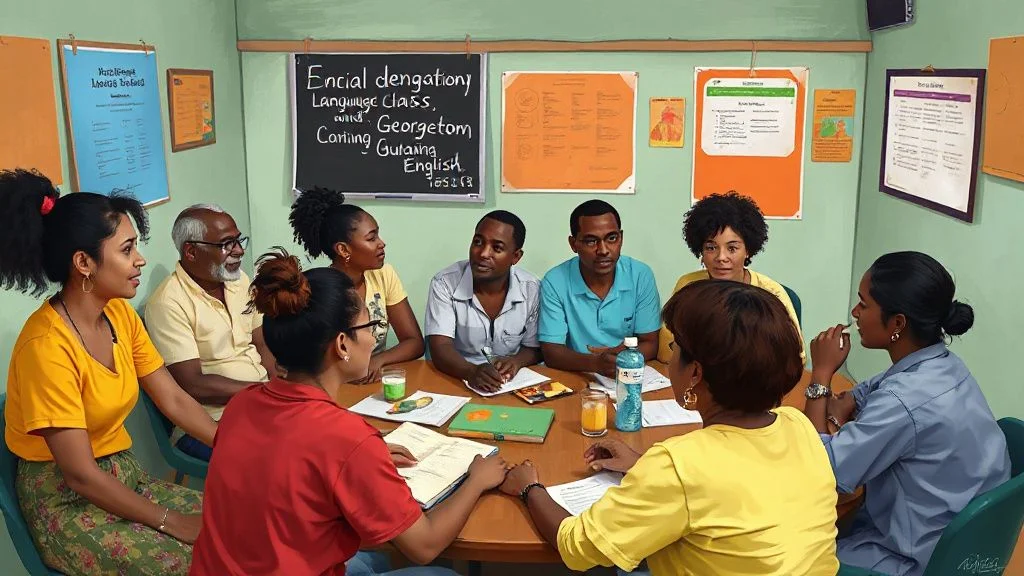
Before anything else, a correction to the premise. Guyana runs its government, its schools and its examinations in English, so an adult who moves here is not facing a foreign language in the way a move to Paramaribo or Bogotá would present one. The useful question is narrower: who actually teaches English to adults here, what do they charge, and is their course aimed at someone who already speaks English and needs a certificate, or at someone who does not speak it at all? Those two things are sold under the same word and they are not the same course.
The nuance the question deserves
English being official does not mean English is everybody's first language. The University of Guyana's own Faculty of Education and Humanities writes that for a large sector of the Guyanese population, English is not the home language, and that it is the vast majority that speaks either Guyanese Creole or an indigenous language. That page is undated and it argues a position rather than reporting a measurement, so read it as the university's view, not as a count. But it explains something you will hear within a week of arriving: the English of a government notice and the English of a market conversation are not the same register, and getting better at one does not automatically deliver the other.
The only language requirement we found in the immigration file
People often assume a work permit carries a language test. In the Immigration Support Services employment application we read on 24 October 2026, the only language rule stated is about paperwork: All supporting documents that are not in English must be submitted along with an English translation. That is a requirement on your documents, not on you. We found no published language test for an employment application. If someone tells you otherwise, ask them to show you where it is written.
What the University of Guyana actually offers adults
The Institute of Distance and Continuing Education is the university's arm for adults and out-of-school youths, and it publishes its list. The courses with a language component are English Language, Business English, Language and Communication, Effective Communication and an Academic Upgrading block that includes English. It also lists Spanish for Beginners and a beginner's French, which tells you the Institute does teach a language from scratch — just not English from scratch.
The entry points are published per course. For English I the stated requirement is Basic literacy skills required — no certificate at all. For English II it is English I, or Skills for Success English, or English up to Third Form at secondary school. For the pre-university Language and Communication course the Institute asks for English at CXC, or English III, or Academic Upgrading English.
The timetable is the part that decides whether this fits around a job. The Institute states One-semester courses of 15-20 weeks duration, offered twice per year. Those two intakes run September to February and March to July. One-year courses run thirty weeks, September to June. Classes meet twice weekly, Mondays and Wednesdays or Tuesdays and Thursdays or Fridays, in the evening. The Institute says that In any given year, the Institute registers in excess of six hundred (600) students at the centers (Georgetown, Anna Regina, New Amsterdam and Linden).
The line on the fee page that expats miss
The fee table carries a heading most readers skip past: Note: Fees Applicable to Non-Guyanese Students Only. If you are not Guyanese, this is the table that applies to you, which makes it the single most relevant page on the site for a foreign resident. Read on 24 October 2026, it gives, for the Academic Upgrading block in which English Language sits:
- One subject: 29,500 course cost plus a 6,500 facilities fee, total 36,000, for 120 hours across two semesters.
- Two subjects: 54,280 plus 20,500, total 74,780.
- Three subjects: 81,420 plus 20,500, total 101,920.
- Four subjects: 108,500 plus 20,500, total 129,000.
- Five subjects: 135,700 plus 20,500, total 156,200.
- Language and Communication I and II, taken as a component of the Industrial Relations and Management programme: 23,600 plus 6,500, total 30,100.
Two warnings about those figures, and please take them seriously. First, the page writes the amounts with a bare dollar sign and does not name the currency. On a Guyanese university site the natural reading is Guyana dollars, but it is a reading, not a statement. Second, the site's footer reads © 2017 University of Guyana, so the page carries no publication date and we cannot tell you when it was last revised. Confirm the currency and the current amount with the Institute before you transfer anything. We are quoting a published list, not a price we verified by paying it.
What the Board of Industrial Training does, and does not, teach
The Ministry of Labour and Manpower Planning points to the Board of Industrial Training as its training arm, and BIT is a genuine, long-standing national institution — its own site dates it to 1910 and places it at 82 Brickdam, Georgetown. So it is worth being precise about what it offers, because it is often recommended to newcomers without anyone checking.
Read on 24 October 2026, BIT publishes eleven programs: Electrical Installation and Maintenance, Plumbing and Pipefitting, Welding and Fabrication, Motor Vehicle Mechanics, Carpentry and Joinery, Masonry and Construction, Air Conditioning and Refrigeration, Information Technology and Computer Servicing, Cosmetology and Beauty Culture, Food Preparation and Culinary Arts, and Agriculture and Agro-Processing. Each is listed at four to six months. The site's own structured data states a price of 0 GYD and describes the tuition as government-subsidized.
None of the eleven is a language course. BIT is a technical and vocational body. If you want English, it is not the door — and knowing that before you walk across Georgetown is worth more than a paragraph of encouragement.
English as a second language: what is published, and what is not
Here is the honest gap. For an adult who does not speak English and wants an open-enrollment course with a published price and timetable, we could not find one. Not at BIT, and not at the Institute, whose English offerings are examination-patterned upgrading for people who already use the language.
The one documented English-as-a-second-language provision we could date is humanitarian rather than commercial. A United Nations Guyana article of 16 September 2021 describes an ESL programme run by UNHCR with support from the Pan American Development Foundation and delivered by the non-governmental organization Voices GY, providing language instruction to some 200 children and adults from Venezuela, with 86 students completing the second term that September. That is a real programme with a real date and a real size — and it is five years old at the time of writing, aimed at a specific group, and we cannot tell you whether it still runs. Treat it as evidence that ESL teaching exists in Guyana, not as a course you can enroll in today.
So where does that leave private tutoring? It exists; people advertise it. We are not naming tutors, agencies or rates, because nothing we could read publishes them. Ask your employer's human resources office and the Institute's Georgetown center for a referral, and insist on a written statement of hours, start date and total cost before you pay.
What expats should know
- Decide which course you actually need: a certificate in English you already speak, or English from scratch. The published provision differs completely.
- The immigration file's only language rule is about documents — anything not in English needs a translation. There is no published language test for the applicant.
- English I at the Institute asks only for basic literacy skills. That is the lowest published entry point we found.
- The fee table is explicitly for non-Guyanese students. That is you.
- The fee page names no currency and carries no date. Confirm both before paying.
- Evening classes run twice a week, in two intakes a year, at four centers.
- The Board of Industrial Training teaches no language. Eleven programs, all technical, four to six months each.
- Nobody publishes an open-enrollment adult ESL course. If a guide names one with a price, ask for the provider's own page.
Where to check
The course list, entry requirements, timetable and fees are from the University of Guyana's Institute of Distance and Continuing Education, with its admission criteria, its administration of courses page and its fee breakdown. The vocational programs are from the Board of Industrial Training, which the Ministry of Labour and Manpower Planning lists as its training body. The document translation rule is from the Immigration Support Services employment application. All read on 24 October 2026. The passage on home language is from the university's Faculty of Education and Humanities, undated. The ESL programme is described by United Nations Guyana in an article dated 16 September 2021.
AI-Generated Content: This article was created with AI assistance and may contain inaccuracies. Please verify important information with official sources.
Primary Sources
- idce.uog.edu.gy
- idce.uog.edu.gy
- idce.uog.edu.gy
- idce.uog.edu.gy
- bit.gov.gy
- labour.gov.gy
- eservices.iss.gov.gy
- feh.uog.edu.gy
- guyana.un.org
Last updated: October 2026
