
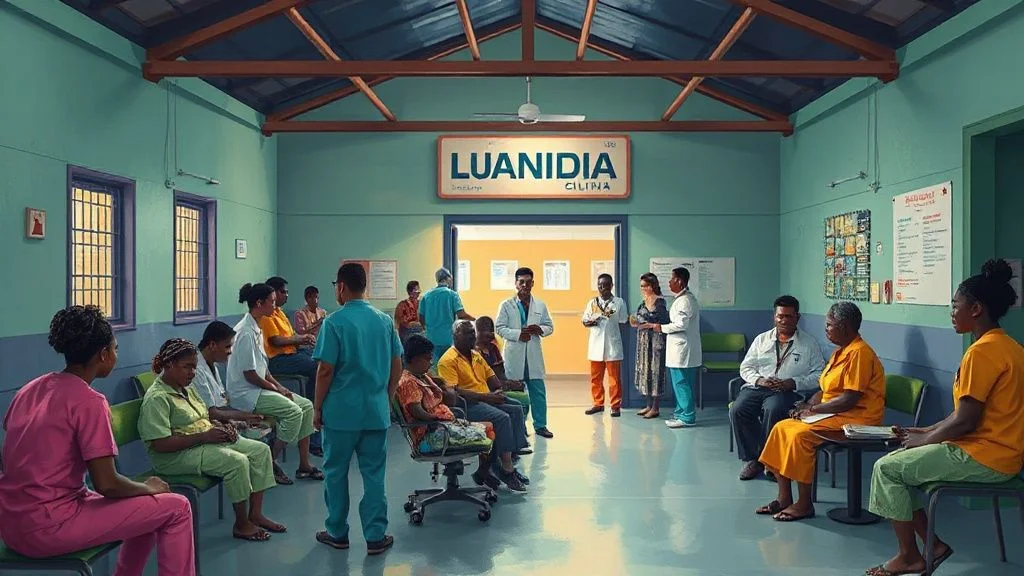
If you want to know how a referral from a clinic to a hospital works in Guyana, the honest answer has to come first: we found no published national referral protocol. Not a patient pathway document, not a referral form, not a published rule about who may refer whom and on what grounds. This article therefore does not describe a procedure as if it were documented. It tells you what is published, what is not, and exactly whom to ask.
Why the previous version of this page was held back
The earlier text set out a confident sequence: what happens at the clinic, what the letter contains, what the admissions desk does with it, how the specialist proceeds. Read as a description of referral systems in general it is unremarkable. Read as a statement about Guyana it is unsourced, and for a reader who needs care that is the difference between a guide and a guess.
So the sequence is gone. What remains is the part that is actually load-bearing: the questions whose answers decide your care, and the bodies that can answer them.
The figures you will see quoted do not answer this question
Search for Guyanese healthcare and you will quickly meet a set of expenditure statistics: total health spending per head of population, the government's share of it, out-of-pocket spending per head, and health spending as a share of gross domestic product. Those series exist, they are properly measured, and their measurement date is 31 December 2023.
They are macroeconomic statistics about a whole country, and they say nothing about a referral. They cannot tell you whether a clinic can send you to a particular hospital, whether a written referral is required, how long it takes, or what you will be charged. We have left them out of this article on purpose. A correctly measured number attached to the wrong question is just as misleading as an invented one.
What is published, and by whom
The body responsible for the public health system is the Ministry of Health, which the Ministry of Labour and Manpower Planning lists among its own quick links, read on 24 October 2026. That is the address for a question about referral.
The National Insurance Scheme publishes sections headed Benefits and Contributions, also read on 24 October 2026. What its pages do not do, on the ones we were able to read, is say anything about referrals. Whether any benefit attaches to treatment that follows a referral is a question for the Scheme, and it is worth asking before you need the answer.
The six questions that actually decide your care
Put these in writing, to the facility you expect to use and to your insurer, and keep the replies:
- Can you approach a specialist or a hospital department directly, or is a referral required first — and does the answer differ between public and private facilities?
- If a referral is required, who may issue it, and is it issued in writing?
- Does the referral name a specific facility, or may you choose?
- What does the referral cost, and what does the consultation that follows it cost — as a written tariff, not a verbal estimate?
- Does your insurance require prior authorization before the referred appointment, and who obtains it?
- What happens if the treatment is not available in the country: who decides, who authorizes an overseas referral, and who pays for travel?
That last one is the question expatriate families most often discover too late, and it is the one no general guide can answer for you.
Do this before you need any of it
None of the following depends on a document we could not find:
- Register with a clinic or doctor while you are well, not during an emergency.
- Carry your own records. Bring your vaccination history, current prescriptions with generic names, allergies, and any imaging or test results you already hold.
- Keep every piece of paper you are given, and photograph it the day you receive it. If a referral is issued on paper, a photograph is your backup.
- Write down the name of whoever tells you something important, and the date.
- Find out now where the nearest emergency department is, and how you would get there at night.
- Read your policy's exclusions before you read its benefits.
Where the real risk sits for a new arrival
Two mismatches catch people, and neither is about a document. The first is the assumption that specialist access works the way it does where you came from; if your home system lets you book a specialist yourself, you may arrive expecting that and lose time. The second is the assumption that an insurer will pay because the care was clinically necessary; insurers pay on process, and a missing prior authorization is a process failure regardless of the medicine.
Both are cheap to settle in advance and expensive to discover in a waiting room. Settle them in writing in your first month.
What expats should know
- No published national referral protocol was found. Treat any step-by-step account, including the one this page used to carry, as unsourced.
- Per-capita health expenditure figures do not describe a referral. They are country-level statistics measured at 31 December 2023.
- The Ministry of Health is the body to ask, and the question should be in writing.
- The National Insurance Scheme publishes benefits and contributions, and nothing about referrals on the pages we read.
- Ask whether direct specialist access exists, and whether the answer differs between public and private care.
- Ask about prior authorization before the appointment, not after.
- Settle the overseas-referral question early: who decides, who authorizes, who pays travel.
- Register with a clinic while you are well, and carry your own records.
Where to check
The Ministry of Health is reachable through the government links published by the Ministry of Labour and Manpower Planning. The benefits and contributions sections are on the National Insurance Scheme site. Both read on 24 October 2026. For anything about a specific clinic, hospital or policy, that clinic, hospital or insurer is the only source — and the answer should be on paper.
AI-Generated Content: This article was created with AI assistance and may contain inaccuracies. Please verify important information with official sources.
